Your chip design team,
powered by AI agents.
Chipmind Agents handle the low-level work — RTL generation, verification, documentation — so your engineers can focus on architecture. Flow-aware. SoC-wide. No lock-in.
Add timer peripheral to APB subsystem
We need a second timer unit connected to the APB bus with interrupt support. Register map should follow the existing timer_0 layout.
@chipmind-agent please implement this, including RTL, updated toplevel, and testbench.
$ chipmind exec task-184
✓ Analyzing design database… 1,247 files indexed
✓ Reading timer_0 register map
✓ Generating timer_1.sv — 284 lines
✓ Updating soc_top.sv — APB mux extended
⟳ Running simulation… pass 3/3
✓ Lint check — 0 violations
✓ All checks passed. Creating PR…
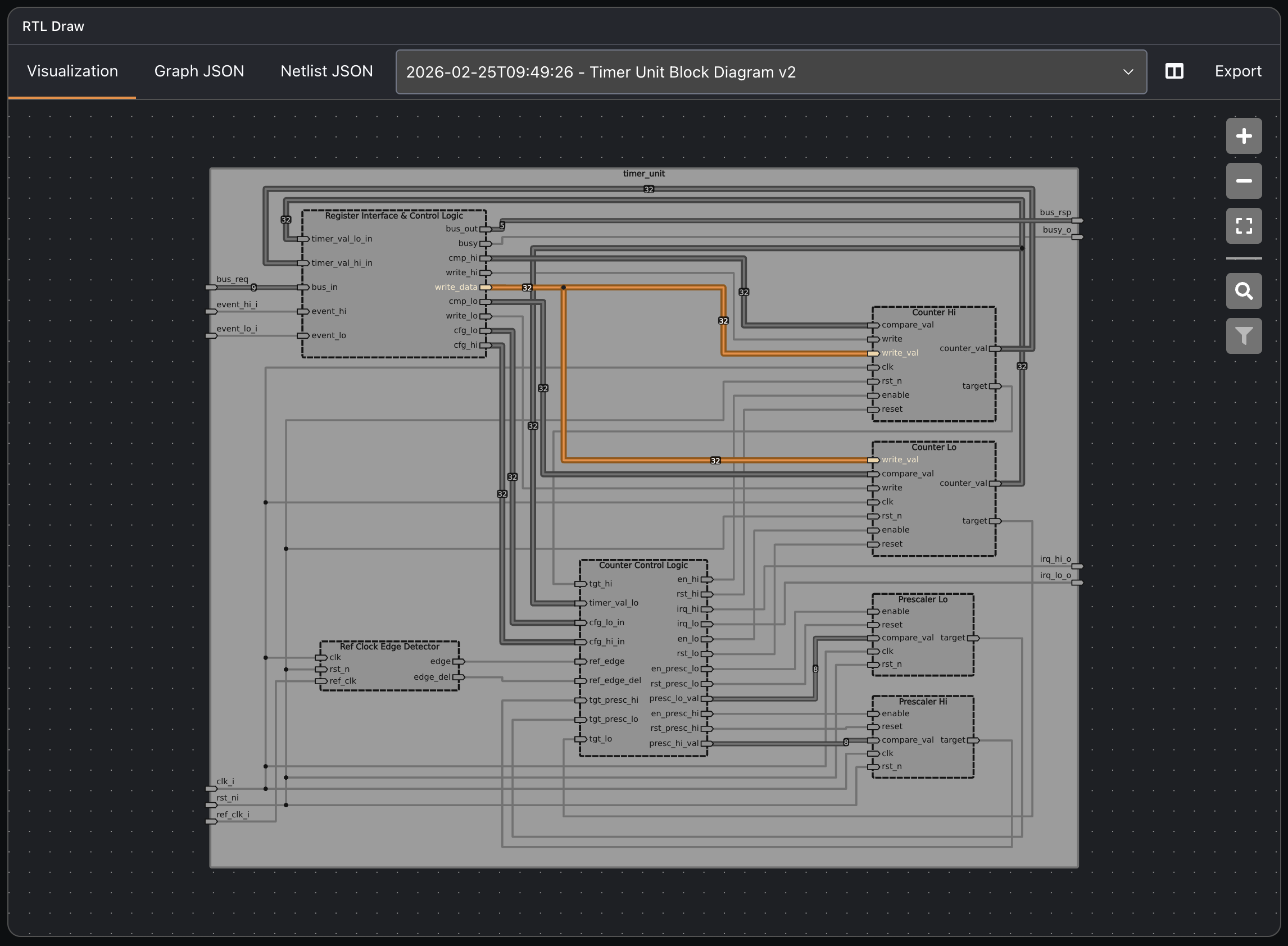
// RTL Draw — Block Diagram
+284 -0 timer_1.sv
+12 -3 soc_top.sv
+96 -0 tb_timer_1.sv
Backed by & Featured in
Built by engineers from ON Semiconductor, u-blox & ETH Zürich — Meet the team →
Your engineers are too valuable to spend half their time on this.
The 40% Problem
Chip design engineers burn up to 40% of their time on repetitive low-level tasks: fixing bugs, writing bus interfaces, updating documentation. That's not a productivity issue — it's a structural one.
Generic AI Makes It Worse
GitHub Copilot and Cursor don't understand your design flow. They're IDE-bound, context-blind, and oblivious to EDA tools. They help with one file at a time while your design spans thousands.
Time-to-Market Won't Wait
Your competitors are moving faster. Every sprint lost to manual RTL work is a market window you won't get back. AI-first teams will ship next-gen chips before you've finished the spec.
You've already tried the alternatives.
Generic coding assistants were not built for chip design. Here's exactly where they fall short — and what Chipmind does differently.
The old way — GitHub Copilot / Cursor
The new way — Chipmind Agents
Meet Chipmind Agents. The first AI agent platform built for chip design flows.
Chipmind Agents don't just suggest code — they understand your entire design database, plan tasks, execute them across your EDA environment, and report back. Interactive when you want oversight. Autonomous when you don't.
- →Flow-aware execution — runs inside your existing EDA flow, not just your IDE
- →SoC-wide context — understands hierarchies, cross-file dependencies, design intent
- →Visual intelligence — generates and navigates block diagrams, FSMs, and RTL structures
Compatible with your existing stack
EDA-tool agnostic. If it has a scripting interface, Chipmind can use it.
From task to result in minutes — not days.
Chipmind Agents plug into your existing flow. No migration. No retraining. No new EDA licenses.
01
Connect
Your environment, your tools.
Chipmind connects to your existing VCS, EDA tools, and HPC cluster. On-prem, VPC, or cloud — your choice.
02
Assign
Drop a task — in plain English.
Open a GitHub issue, type an @mention, or use the Chipmind GUI. No new syntax. No scripts. Just describe what you need.
03
Execute
Agents plan and run it — autonomously.
The agent reads your design context, plans the task, runs your EDA tools, and iterates until the result is correct.
04
Review
PR ready. Audit trail included.
Results come back as a reviewable PR with full execution log. You stay in control — agents handle the work.
Everything your design flow needs. Nothing it doesn't.
A complete platform — not a collection of prompts.
In-flow execution
Runs headless in your CI/CD and EDA — no context switching
SoC-wide understanding
Deep hierarchical context across thousands of files
Visual intelligence
Interactive block diagrams and FSMs — see what agents do
Confidential by design
Your IP never leaves your environment. On-prem, VPC, or fully air-gapped — zero exposure by default.
Universal compatibility
EDA-agnostic, LLM-agnostic, no hyperscaler dependency
Confidential by design
Your IP never leaves your environment. Unless you want it to.
Chip designs are among the most sensitive assets in tech. Chipmind was built for environments where security isn't optional — it's the baseline.
Cloud — Private Endpoint
Azure/AWS with enterprise-grade data isolation. Your design data is never used for model training. Private endpoint ensures zero exposure.
Customer VPC — Local LLMs
Run Chipmind inside your own VPC with locally hosted models. Full control over data flow. No traffic leaves your network perimeter.
On-Prem / Air-Gapped
Local GPU infrastructure running open-source LLMs. No internet connection required. Built for defence, automotive, and high-security semiconductor environments.
Isolated execution environments ensure that every agent task runs in a contained, ephemeral runtime. No cross-project leakage. No persistent access. Design context is loaded per task and cleaned up on completion.
Compatible with your existing security policies — SOC 2, ISO 27001, and customer-specific frameworks.
Continuous learning loop
The more your team uses Chipmind, the better it gets.
Every task execution feeds back into the system. Chipmind learns your codebase, your conventions, and your design patterns — building a proprietary knowledge base unique to your team.
Your Design Data
1,000s of files · per customer
Chipmind connects to your codebase, specs, and design files. Every RTL module, testbench, and constraint becomes part of the agent's context.
Context Engineering
Deep context · not flat prompts
Agents dynamically retrieve the right context — not just chat history, but hierarchies, register maps, and cross-file dependencies. Memory that grows with every task.
agent: retrieving context for timer_1…
+ timer_0.sv — register map, FSM structure
+ soc_top.sv — APB bus connections
+ coding_guidelines.md — naming, reset policy
ctx: 4 files, 2,847 lines of relevant context
Autonomous Execution
EDA tools · simulations · lint
Agents write RTL, run simulations, analyze waveforms, and iterate — using your actual EDA tools. Not suggestions. Real execution with real tool output.
✓ Generated timer_1.sv — 284 lines
✓ Running VCS simulation… pass
⟳ Lint violation on line 42 → auto-fixing…
✓ Re-run lint — 0 violations
Tangible Artifacts
PRs · RTL · diagrams · tests
Every task produces committable code, block diagrams, and verification evidence. Results come as reviewable PRs with full audit trails.
PR #428
3 files changed
+392 -3
Block Diagram
Auto-generated
RTL Draw ↗
Tests
3/3 passing
✓ all pass
Trajectory Learning
1,000s of hours of agent data
Every execution — successes and debugging paths — feeds back into Chipmind's proprietary chip-trajectory datasets. Your agent gets sharper with every task.
Your data stays yours.
Customer design data never leaves your environment. Trajectory learning happens on aggregated, anonymized execution patterns — not on your IP.
Real engineers. Real results.
From actual PoC engagements with European semiconductor teams.
0× faster
46 min → 7 min
“Chipmind Agents know my tool in and out. I can get the same thing done in 4 minutes with just 3 prompts. It's a significant improvement to the workflow.”
— Senior Verification Engineer, Semiconductor Company
0× faster
4 hours → 18 min
“The agents generated all the RTL, extended the testbenches, and ran the simulation successfully. I'm really looking forward to using it in my daily work.”
— Junior Digital IC Design Engineer, European Semiconductor Company
0× faster
21 min → 5 min
“With Chipmind Agents this became a matter of a couple of prompts.”
— Application Engineer, Digital Chip Design Service Company
Built by people who lived this problem.
Harald (ON Semiconductor, u-blox) and Sandro founded Chipmind after years inside broken design flows. They built what they wished had existed.
Frequently asked questions
From a team of engineers — for engineers and the people who manage them.
Does Chipmind replace our EDA tools or our EDA licenses?+
Neither. Chipmind Agents operate on top of your existing EDA environment — they execute tasks using the tools you already have. Nothing gets replaced. Nothing gets installed on every workstation. You keep your existing licenses and workflows.
How do you protect our proprietary RTL and design data?+
Your IP stays in your environment by default. Chipmind offers three deployment modes: cloud (private endpoint, no model training), customer VPC with local LLMs, and fully on-prem / air-gapped. Design data is never shared with third parties and never used to train models.
Which EDA tools and simulators does Chipmind support?+
Chipmind Agents are EDA-tool agnostic. They work with tools from Synopsys, Cadence, Siemens EDA, and open-source flows (e.g. Verilator, Icarus, OpenROAD). If your tool has a scripting interface, Chipmind can use it.
What does a PoC look like — how much does it ask of our team?+
A typical PoC runs 4–6 weeks. We start with a joint KPI session to define one or two concrete tasks from your real workload. Our team handles integration. Your engineers evaluate the results. No internal ML expertise required — and everything is covered by an NDA from day one.
Can Chipmind run in an air-gapped environment?+
Yes. On-prem deployment with local LLMs (e.g. Llama-based models on your GPU infrastructure) is a supported configuration. No internet connection required. This makes Chipmind suitable for defence, automotive, and high-security semiconductor environments.
Do we need a dedicated AI or ML engineer to operate it?+
No. Chipmind is designed to be operated by chip design engineers, not ML specialists. Setup and integration is handled by Chipmind during the PoC phase. Ongoing use requires only standard chip designer skills — no Python expertise, no model fine-tuning.
See Chipmind
in action.
We work in your environment, with your EDA tools, on your real designs. No ramp-up. No disruption. NDA protected from day one.
- ✓6–14× speed-up on real tasks
- ✓IP stays in your environment
- ✓EDA-agnostic. No new licenses.
We respond within 1 business day. Press, investors, partnerships →